Cthulhu |
|
Cthulhu es una entidad ficticia ideada por el autor de ficción y terror Howard Phillips Lovecraft; cuya mitología versa sobre extraños seres extraterrestres que habitaron la Tierra mucho antes de que los hombres aparecieran y de sus intentos presentes por recuperarla. Cthulhu es un personaje sacado de la literatura de H.P. Lovecraft. Lovecraft formó con algunos de sus cuentos una mitología de horror basada en la existencia de universos paralelos y seres provenientes de ellos, entre los que se encuentra Cthulhu (incluso algunos como Cthulhu viven en este planeta); y que existieron "antes del tiempo", y cuyo contacto con los humanos tiene terribles consecuencias. Dentro de sus historias, el tema es el caos primordial, y Lovecraft introduce la noción de que todo lo que conocemos tiene sentido únicamente dentro de nuestro espacio-tiempo; cuando ocurre un evento que rompe con el espacio-tiempo comienza la locura. Dentro de esta cosmología conocida como los Mitos de Cthulhu, Cthulhu es emblema, personaje central y una de las figuras recurrentes; y aunque no es el más poderoso, si es el más popular de todos estos seres, y se encuentra en la obra La llamada de Cthulhu.
|
|
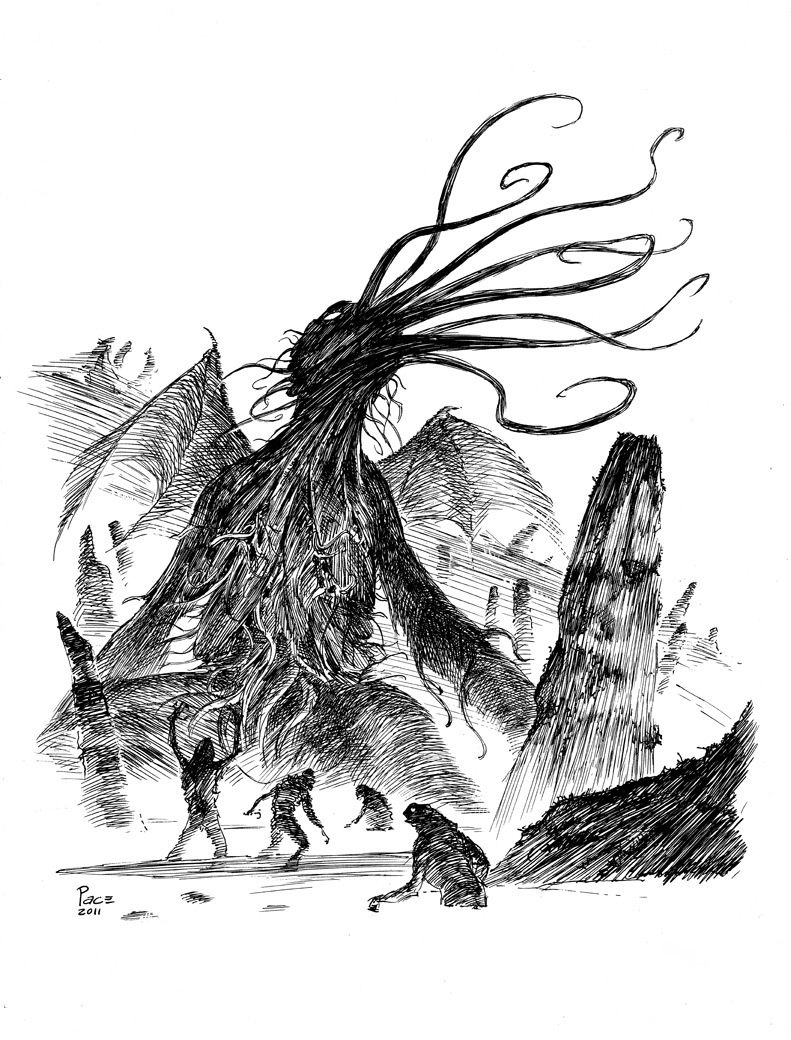
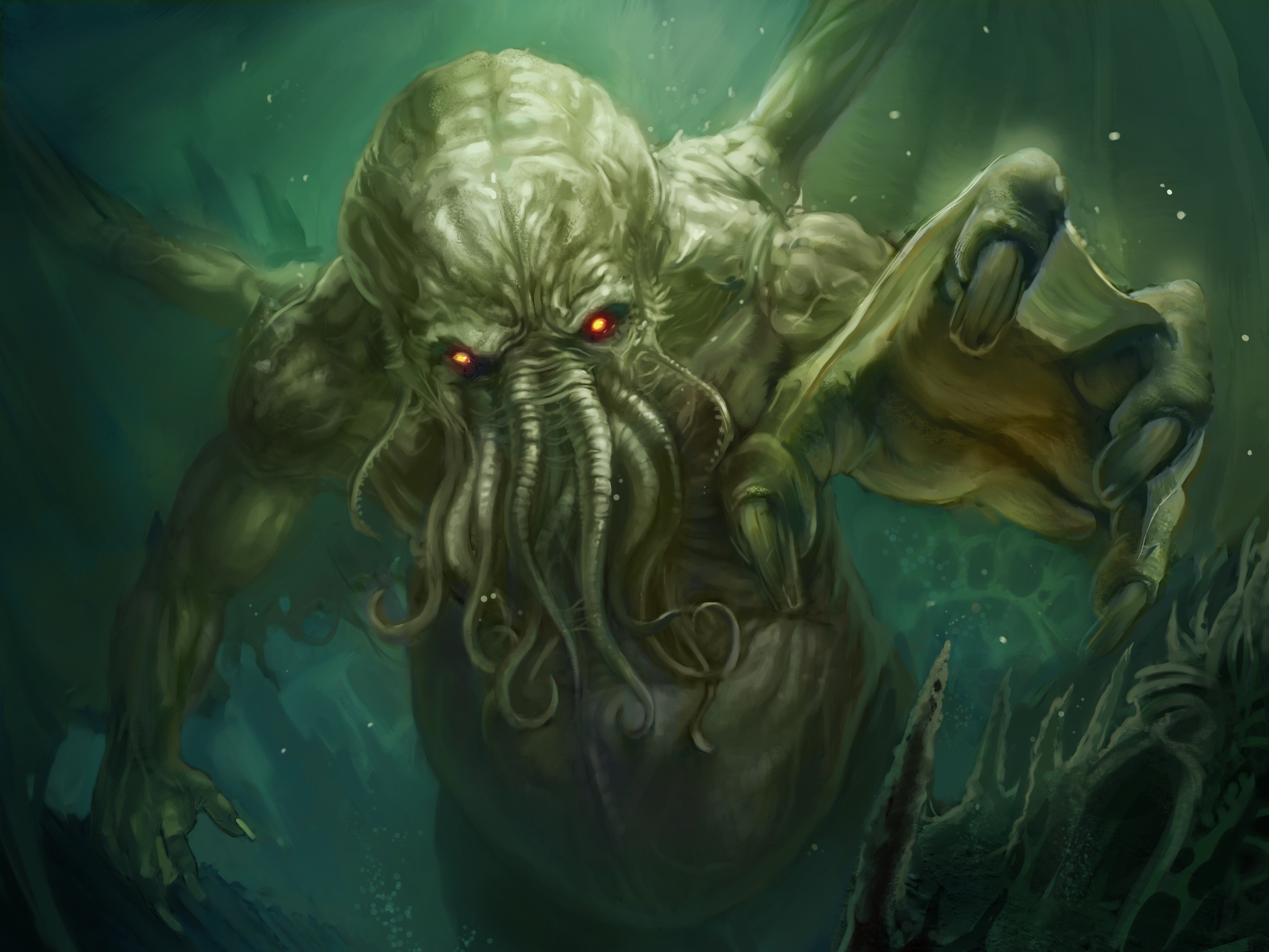
Se describe -precisamente en el relato de La llamada de Cthulhu- como una enorme criatura comparable a una montaña desplazándose, con cabeza de pulpo o calamar, y abotargado cuerpo de dragón, con sus respectivas alas rudimentarias. Tiene la capacidad de alterar su forma, aunque siempre es básicamente la misma. Su cuerpo escamoso está compuesto por una sustancia distinta a las que se encuentran en nuestro planeta, una especie de masa gelatinosa que lo hace prácticamente indestructible. De todos modos, incluso si su cuerpo físico es destruido por completo (cosa muy improbable), su naturaleza extraterrenal lo haría volver a formarse en horas. Fue uno de los conquistadores de la Tierra y dominó desde las profundidades del océano.
Pronunciación No existe acuerdo respecto a la pronunciación del nombre. Lovecraft la transcribió como «Khlûl'hloo» IPA ˈχɬʊl.ɬuː, español «jluljlu» o «Kathooloo» IPA [kaθu'lu], español «kazulú» (con pronunciación ibérica en la z). Se aceptan [k.θulxu], [k.tu'lu], [k.θu'lu], [θetu'lu], [θeθul'hu], [ʧulu], ['tulu], ['xhukutulju], [θulu], [Oish] [kuθulu] o [katulu], como pronunciaciones válidas,[cita requerida] pero se conviene en que la forma más apropiada de hacerlo no puede ser pronunciada por el aparato fonador humano.
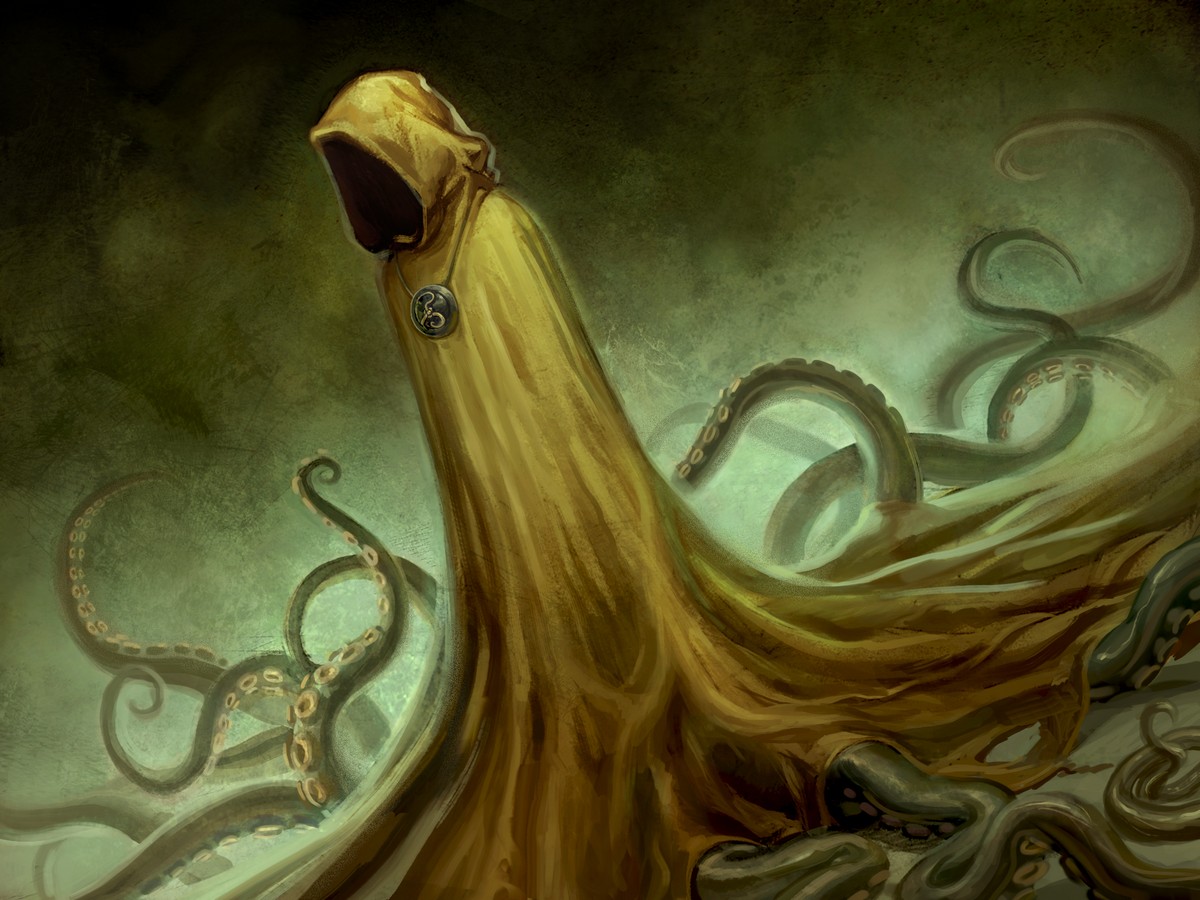
La semilla estelar de Cthulhu Los siervos de Cthulhu son seres similares al mismo Cthulhu, pero más pequeños, los cuales son seguidores y sirvientes de Cthulhu; e igual que su amo, pueden alterar ligeramente su forma. Llegaron junto con su amo a la Tierra, y la gran mayoría están encerrados con Cthulhu en R'lyeh, o en mundos lejanos, como Aldebarán; pero algunos están libres. Sirven a Cthulhu llevando a cabo sus deseos, y han hecho guerras con otros seres. Es así como al llegar a la Tierra con él, lucharon con los Antiguos, y construyeron la ciudad de R'Lyeh. |
|
Dioses Primigenios son entidades del tipo de dioses o pseudodemonios de inmenso poder y generalmente de un tamaño colosal. No obstante, son en general menos poderosos e influyentes que las entidades conocidas como los Dioses Exteriores (Azathoth, Nyarlathotep...). Los Primigenios son adorados por sectas de humanos trastornados, además de muchas de las razas no humanas de los mitos. Según los relatos de los mitos, en la actualidad los Primigenios están presos, algunos bajo las aguas del océano, otros bajo la tierra, otros en lejanos sistemas planetarios o incluso más allá |
|
Hastur Sus adoradores se refieren a él como El Que No Debe Ser Nombrado; está desterrado junto al lago de Hali, en un planeta de Aldebarán, en las Híades. Por cierto, no es invención de Lovecraft, sino de un escritor de terror, Robert Chambers. El lago de Hali es creación del escritor Ambrose Bierce.
|
|
Cthulhu is a fictional cosmic entity who first appeared in the short story "The Call of Cthulhu", published in the pulp magazine Weird Tales in 1928. The character was created by writer H. P. Lovecraft. Spelling and pronunciation[edit source | edit] Cthulhu has also been spelled as Tulu, Clulu, Clooloo, Cthulu, Cthullu, C'thulhu, Cighulu, Cathulu, C'thlu, Kathulu, Kutulu, Kthulhu, Q’thulu, K'tulu, Kthulhut, Kutu, Kulhu, Kutunluu, Ktulu, Cuitiliú, Thu Thu, and in many other ways. It is often preceded by the epithet Great, Dead, or Dread. Lovecraft transcribed the pronunciation of Cthulhu as "Khlûl'hloo" (IPA: [ˈχɬʊl.ɬuː] ?).S. T. Joshi points out, however, that Lovecraft gave several differing pronunciations on different occasions. According to Lovecraft, this is merely the closest that the human vocal apparatus can come to reproducing the syllables of an alien language. Long after Lovecraft's death, the pronunciation /kəˈθuːluː/ kə-thoo-loo became common, and the game Call of Cthulhu endorsed it. Appearance[edit source | edit] In "The Call of Cthulhu", H. P. Lovecraft describes Cthulhu as "A monster of vaguely anthropoid outline, but with an octopus-like head whose face was a mass of feelers, a scaly, rubbery-looking body, prodigious claws on hind and fore feet, and long, narrow wings behind." Cthulhu has been described as a mix between a giant human, an octopus, and a dragon, and is depicted as being hundreds of meters tall, with human-looking arms and legs and a pair of rudimentary wings on its back. Cthulhu's head is depicted as similar to the entirety of a giant octopus, with an unknown number of tentacles surrounding its supposed mouth. Cthulhu is described as being able to change the shape of its body at will, extending and retracting limbs and tentacles as it sees fit. Publication history[edit source | edit] H. P. Lovecraft's initial short story, "The Call of Cthulhu", was published in Weird Tales in 1928 and established the character as a malevolent entity hibernating within an underwater city in the South Pacific called R'lyeh. The imprisoned Cthulhu is apparently the source of constant anxiety for mankind at a subconscious level, and also the subject of worship by a number of human religions (located several places worldwide, including New Zealand, Greenland, Louisiana, and the Chinese mountains) and other Lovecraftian monsters (called Deep Ones and Mi-Go). The short story asserts the premise that, while currently trapped, Cthulhu will eventually return. His worshipers chant "Ph'nglui mglw'nafh Cthulhu R'lyeh wgah'nagl fhtagn" ("In his house at R'lyeh, dead Cthulhu waits dreaming.") Lovecraft conceived a detailed genealogy for Cthulhu (published as "Letter 617" in Selected Letters) and made the character a central figure in corresponding literature. The short story "The Dunwich Horror" (1928) refers to Cthulhu, while "The Whisperer in Darkness" (1930) hints that one of his characters knows the creature's origins ("I learned whence Cthulhu first came, and why half the great temporary stars of history had flared forth."). The 1931 novella At the Mountains of Madness refers to the "star-spawn of Cthulhu", who warred with another race called the Elder Things before the dawn of man. August Derleth, a correspondent of Lovecraft, used the creature's name to identify the system of lore employed by Lovecraft and his literary successors: the Cthulhu Mythos. In 1937, Derleth wrote the short story "The Return of Hastur", and proposed two groups of opposed cosmic entities: ... the Old or Ancient Ones, the Elder Gods, of cosmic good, and those of cosmic evil, bearing many names, and themselves of different groups, as if associated with the elements and yet transcending them: for there are the Water Beings, hidden in the depths; those of Air that are the primal lurkers beyond time; those of Earth, horrible animate survivors of distant eons. Derleth's interpretations have been criticized by Lovecraft enthusiast Michel Houellebecq. Houellebecq's H P Lovecraft: Against the World, Against Life (2005) decries Derleth for attempting to reshape Lovecraft's strictly amoral continuity into a stereotypical conflict between forces of objective good and evil. The character's influence also extended into recreational literature: games company TSR included an entire chapter on the Cthulhu mythos (including statistics for the character) in the first printing of Dungeons & Dragons sourcebook Deities & Demigods (1980). TSR, however, were unaware that Arkham House, who asserted copyright on almost all Lovecraft literature, had already licensed the Cthulhu property to the game company Chaosium. Although Chaosium stipulated that TSR could continue to use the material if each future edition featured a published credit to Chaosium, TSR refused and the material was removed from all subsequent editions. Legacy[edit source | edit] See also: Cthulhu Mythos in popular culture Two microorganisms that assist in the digestion of wood by termites have been named after Cthulhu and Cthulhu's "daughter" Cthylla: Cthulhu macrofasciculumque and Cthylla microfasciculumque, respectively. See also[edit source | edit] Mythology portal ^ The u is similar to that in full; with the first syllable not unlike klul in sound, hence the h represents the guttural thickness (H. P. Lovecraft, Selected Letters V, pp. 10 – 11.). According to Lovecraft, this is the closest that the human vocals can come to reproducing the syllables of an alien language ("Cthul-Who?: How Do You Pronounce 'Cthulhu'?", Crypt of Cthulhu #9). It has been noted, however, that Lovecraft provided several different pronunciations,(S. T. Joshi, note 9 to "The Call of Cthulhu", The Call of Cthulhu and Other Weird Stories) with many variations in spelling also existing (Harms, "Cthulhu," "PanChulhu," The Encyclopedia Cthulhiana, p. 64.). Bloch, Robert (1982). "Heritage of Horror". The Best of H. P. Lovecraft: Bloodcurdling Tales of Horror and the Macabre (1st ed.). Ballantine Books. ISBN 0-345-35080-4. |
|