Las rapaces nocturnas o estrigiformes (Strigiformes) |
||
| son un orden de aves compuesto por la familias Tytonidae (lechuzas), y la familia Strigidae que incluye búhos, mochuelos, tecolotes, autillos, cárabos, el ñacurutú y el chuncho, entre otras. Se encuentran en todo el mundo, excepto en la Antártida, la mayor parte de Groenlandia y en algunas islas remotas. Son grandes cazadores, de generalmente hábitos nocturnos y solitarios. Se alimentan principalmente de pequeños mamíferos, insectos y otras aves, aunque algunas especies se especializan en la pesca. | ||
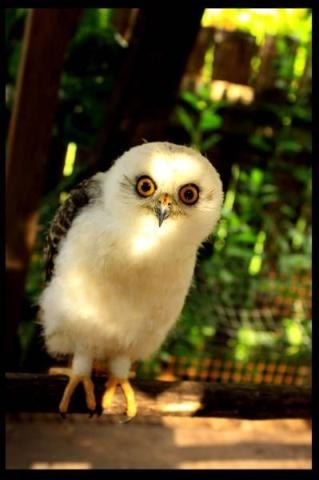
El Nínox halcón (Uroglaux dimorpha), también conocido como Búho aguilucho de Nueva Guinea,1 es una especie de búho incluida en la familia Strigidae del orden Strigiformes. Es el único miembro del género monotípico Uroglaux. Es endémica de la isla de Nueva Guinea. No tiene subespecies reconocidas Status: Very scarce to rare, probably threatened |
 |
 |
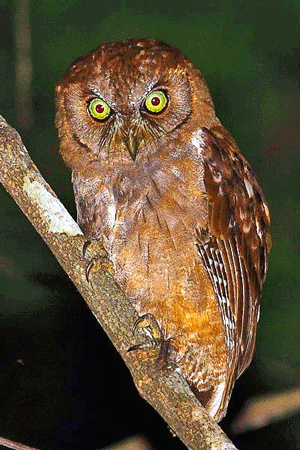
The Pemba Scops-owl, Petit-duc De Pemba, or Autillo De Pemba (Otus pembaensis) is a species of owl in the Strigidae family. It is endemic to Tanzania. Its natural are subtropical or tropical moist lowland and . It is threatened by habitat loss |
 |
 |
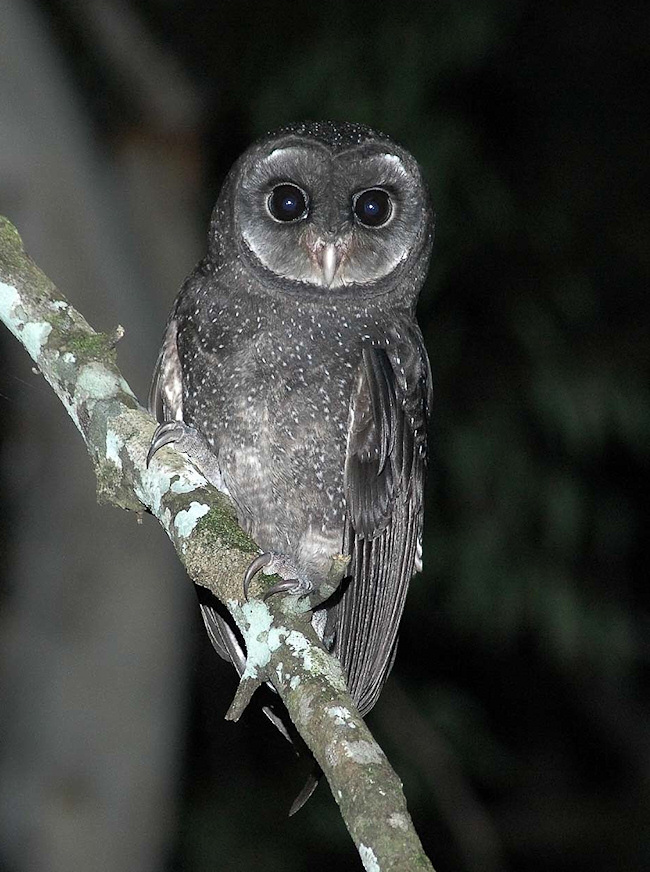
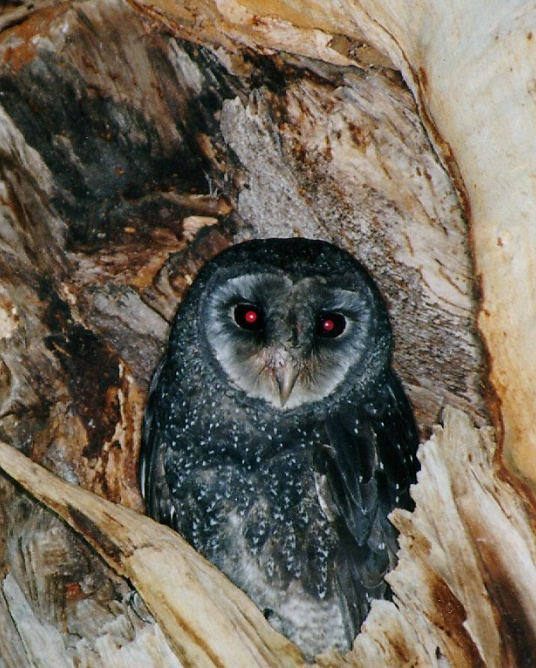
Greater Sooty Owl - Tyto tenebricosa. Known also as Black Owls or Dusky Barn Owls, these birds are rarely seen or heard. Description: A medium large, sooty black Owl with very large, dark eyes set in a round facial disc. The upperparts are sooty black, finely spotted white on the head with larger but sparser white spots on the wings. The Facial disc is large, round and sooty black through to dark grey or silver and is heavily edged black. The underparts vary from sooty black to dark grey, (never as dark as the upperparts) finely spotted with white. The Belly is always paler than the breast. The tail is very short, the legs feathered and eyes very large with a black iris. A Sooty Owl's Bill is horn coloured and feathered almost to the tip. Toes are dark grey and the large talons black. Sexes are similar in plumage and Females are usually slightly larger than males. They are distinguished from lesser Sooty Owls by much larger size and darker plumage, sparser white spots on upperparts and darker underparts which have white spots on a dark background where the lesser Sooty Owl has dark chevrons on a pale background. |
 |
 |
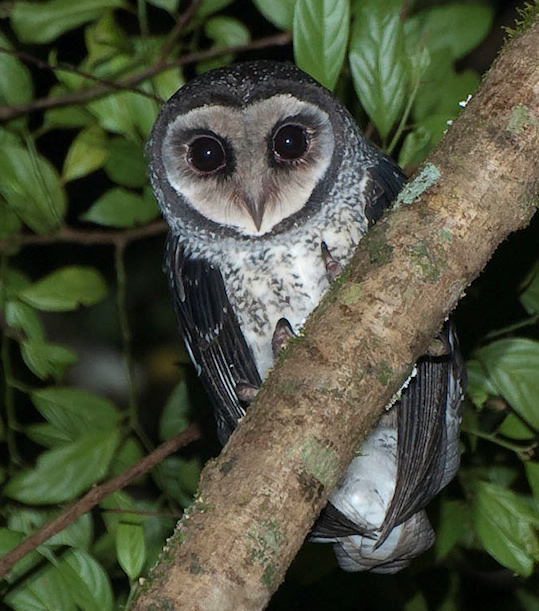
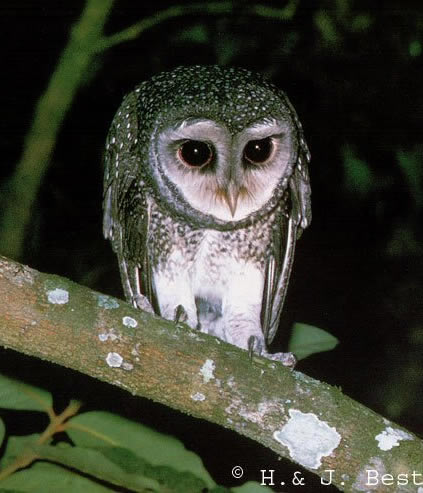
Lesser Sooty Owl - Tyto Multipunctata These smaller cousins to the Sooty Owl of the south inhabit the north Queensland rainforests. They are sometimes called the Silver Owl. Description: A small to medium, sooty black Owl with silvery white underparts. They have many similarities to the Sooty Owl but are lighter in colour and noticeably smaller. The upperparts are sooty black or grey-brown with large numbers of fine silvery white spots on the head and wings. They have a large round facial disc with silvery white shading to black around the eyes - the face is heavily edged black. Underparts are silvery white with many fine dark grey or sooty black chevrons, particularly on the breast. Lesser Sooty Owls have very short tails. Their eyes are very large with a black Iris. The beak is pale horn. Toes are pale grey with black talons. Sexes look similar but the female is usually slightly larger. |
 |
 |
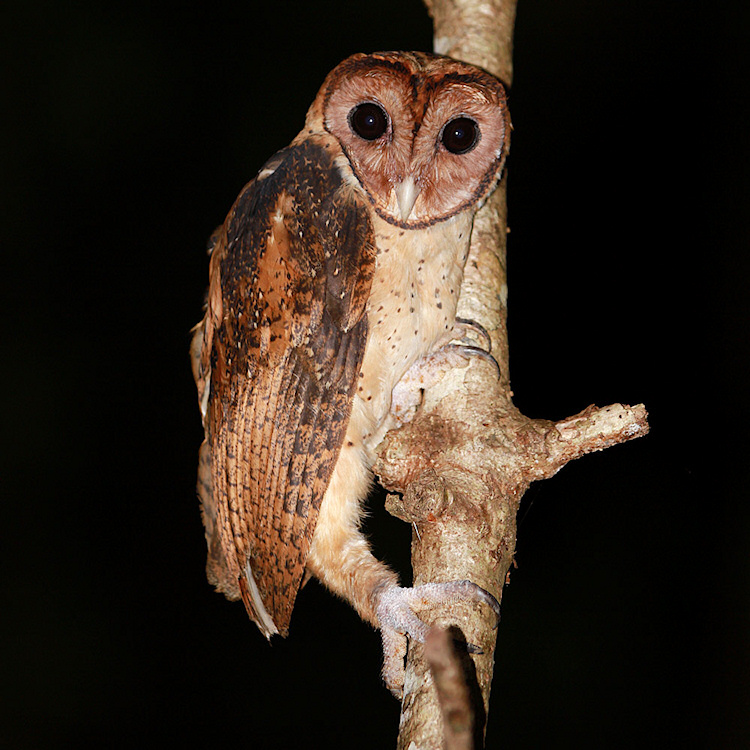
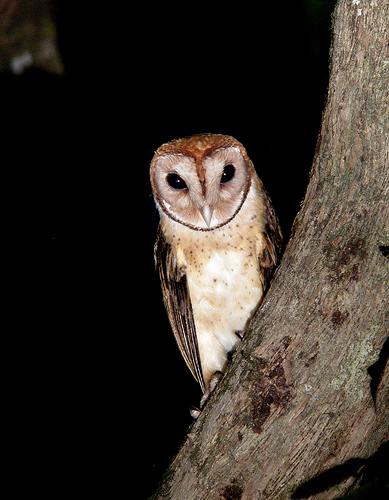
Minahassa Barn Owl - Tyto inexspectata 30 cm. Medium-small, forest-dwelling owl. Light rusty facial disk. Rusty upperparts speckled black, rusty-cream underparts spotted black, wings barred black and rufous. Finely barred tail. Nuchal area and bend of wing darker than rest of plumage. Black iris. Similar spp. Sulawesi Owl T. rosenbergi is much larger, with dusky facial disc and upperparts finely spotted white. There are two morphs of this species, of which the darker is most difficult to differentiate from T. rosenbergi. Voice Single nasal, hoarse, hissing shriek lasting about 1.8 seconds and delivered infrequently every 5-7 minutes (Mauro and Drijvers 2000). |
 |
 |
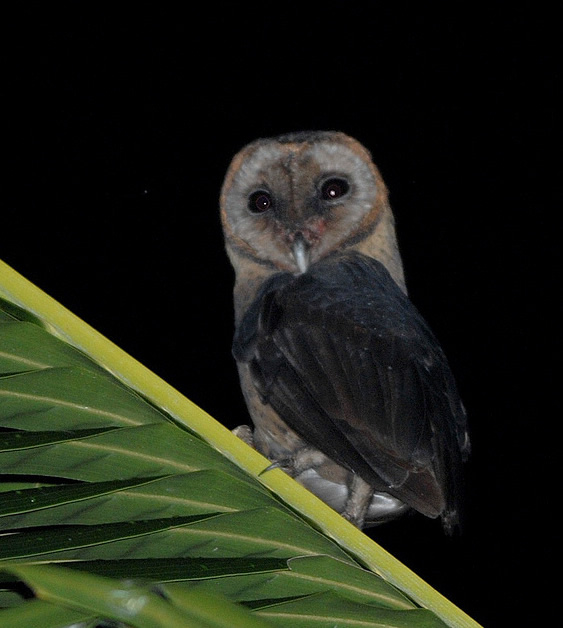
Taliabu Masked Owl - Tyto nigrobrunnea Status: Extremely rare, listed as Vunerable by Birdlife internationalStatus: Extremely rare, listed as Vunerable by Birdlife international |
 |
|
Lesser Masked Owl - Tyto sororcula Also known as Moluccan Masked Owl. Description: The facial disc is pale rufous-brown, with a brownish rim that is finely speckled ochre-yellow. There is a brownish wash around the eyes, extending to the base of the bill. The eyes are blackish-brown and the bill yellowish-cream. Size: Length 29-31cm. Wing length 227-251mm. No weight data available. Habits: Little known. Sometimes hides in limestone caves during the day. Voice: Three rapidly screeched whistles over a two second period. This is sometimes preceded by 3-4 slower, more drawn-out, higher pitched screeches. Hunting & Food: Not studied, probably similar to other Tyto species. Breeding: The breeding habits of the Lesser Masked owl have not been studied. Probably nests in tree hollows. Habitat: Presumed to live in primary forest. Distribution: The islands of Tanimbar and Buru in the Lesser Sundas. Has also reportedly been seen on Seram Island. |
 |
 |
Common Barn Owl - Tyto alba These pale, nearly worldwide, birds are closely associated with man through their traditional use in the Old World of barn lofts and church steeples as nesting sites. Although widely known beforehand, it was in 1769 when the Barn Owl was first officially described by Giovanni Scopoli, an Italian naturalist. The species name "alba" also refers to the colour white. Other names for the Barn Owl have included Monkey-faced Owl, Ghost Owl, Church Owl, Death Owl, Hissing Owl, Hobgoblin or Hobby Owl, Golden Owl, Silver Owl, White Owl, Night Owl, Rat Owl, Scritch Owl, Screech Owl, Straw Owl, Barnyard Owl and Delicate Owl. Description: The Upperparts are light grey with numerous fine dark lines and scattered pale spots on the feathers. There are buff markings on wings and on the back. The underparts are white with a few black spots, occasionally none. Feathering on the lower legs may be sparse. The heart-shaped facial disc is white with a brownish edge, with brown marks at the front of the eyes, which have a black iris. Its beak is off-white and the feet are yellowish-white to brownish. Males and females are similar in size and colour, females and juveniles are generally more densely spotted. Size: Female: Length 34-40cm (13.5-15.5") Wingspan 110cm (43") Weight 570g (20oz) Habits: Generally nocturnal, although it is not uncommon to see this species emerge at dusk or be active at dawn, occasionally being seen in flight during full daylight. Flight is noiseless, with wingbeats interrupted by gliding. Voice: The Barn Owl calls infrequently, the usual call being a drawn-out rasping screech. The courtship call of male at nest is a shrill repetitive twittering. Adults returning to a nest may give a low, frog-like croak. When surprised in its roosting hollow or nest, it makes hissing and rasping noises and snapping sounds that are often called bill snapping, but possibly made by clicking the tongue. Hunting & Food: Barn Owls specialise in hunting small ground mammals, and the vast majority of their food consists of small rodents. Voles (field mice) are an important food item, as well as pocket gophers, shrews, mice and rats. Barn Owls breed rapidly in response to mouse plagues. Other prey may include baby rabbits, bats, frogs, lizards, birds and insects. Prey are usually located by quartering up and down likely looking land - particularly open grassland. They also use low perches such as fence posts to seek quarry.
|
 |
 |
Breeding: Barn Owls will breed any time during the year, depending on food supply. In a good year, a pair may breed twice. Rodent plagues cause Barn Owl numbers to increase dramatically. During courting, males may circle near the nest tree, giving short screeches and chattering calls. The majority of Barn Owls nest in tree hollows up to 20 metres high. They will also nest in old buildings, caves and well shafts. 3 to 6 eggs are laid (occasionally up to 12) at 2 day intervals. The eggs are 38 to 46mm (1.5-1.8") long and 30 to 35mm (1.2-1.4") wide and will be incubated for 30 to 34 days. Chicks are covered in white down and brooded for about 2 weeks, and are fledged in 50 to 55 days. After this, they will remain in the vicinity for a week or so to learn hunting skills and then rapidly disperse from the nest area. Young birds are able to breed at about 10 months. Mortality: Barn Owls are short-lived birds. Most die in their first year of life, with the average life expectancy being 1 to 2 years in the wild. In North America the oldest known Barn Owl in the wild lived to be 11 years, 6 months. In Holland, a wild barn owl lived to be 17 years, 10 months old. Habitat: The Barn Owl is found in virtually all habitats but much more abundantly in open woodland, heaths and moors than forested country. They usually roost by day in tree hollows but have also been found in caves, wells, out-buildings or thick foliage. Distribution: The Barn Owl is one of the most wide-spread of all land birds. They are found on all continents (except Antarctica) and large islands and occur over the whole of Australia, including Tasmania. They occur throughout most of Britain and Europe and across many parts of Asia, Africa, and in much of North America. In South America they are found in areas of suitable grassland, as well as on oceanic islands such as the Galapagos. They were introduced to Hawaii in 1958. |
 |
 |